
Industry news
How EU PPWR Affects Plastic Bags: Key Compliance Requirements for B2B Buyers in 2026–2030
 The European Union’s Packaging and Packaging Waste Regulation (PPWR, Regulation (EU) 2025/40) has reshaped the rules for packaging placed on the EU market. For companies that buy or use plastic bags — whether as primary packaging, secondary packaging, or transport packaging — understanding the new requirements is essential to maintain market access and avoid supply-chain disruption.
The regulation became applicable on 12 August 2026. From that date, all packaging must meet basic substance restrictions and be designed for recyclability. Manufacturers are required to carry out a conformity assessment and issue a Declaration of Conformity before placing packaging on the market. Heavy-metal limits remain in force, and strict PFAS restrictions now apply to food-contact packaging. These immediate obligations already affect every plastic bag supplied into the European Union.
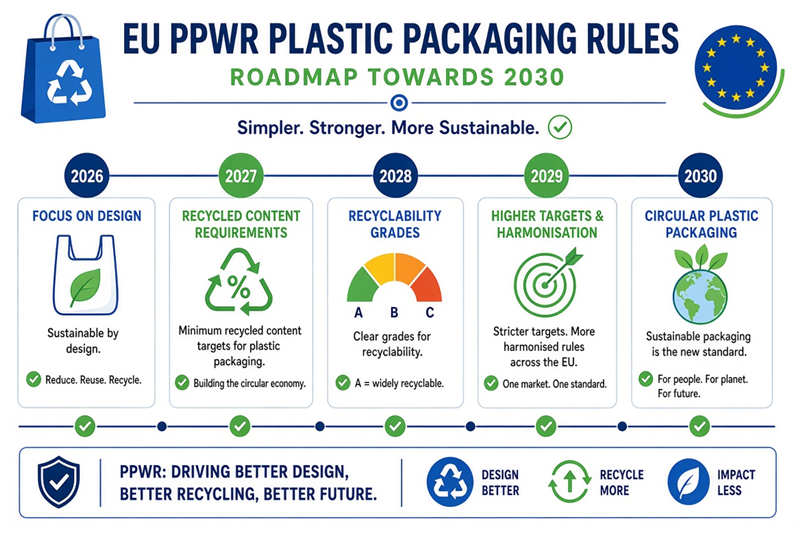
Looking ahead to 2030, the rules become significantly stricter. All packaging must achieve at least Grade C recyclability (70 % or higher by weight) under the design-for-recycling criteria. Plastic packaging must also contain minimum levels of post-consumer recycled content. For most non-contact-sensitive plastic packaging the target is 35 %. Contact-sensitive packaging faces different thresholds depending on the polymer (for example, 10 % for non-PET contact-sensitive packaging and 30 % for PET). These percentages rise further in 2040. In parallel, packaging must be minimised in weight and volume, and certain single-use formats, including many very lightweight plastic carrier bags, face restrictions or bans.
For B2B buyers these changes create both risk and opportunity. Non-compliant bags can no longer be freely placed on the EU market, potentially leading to rejected shipments, fines, or the need for costly redesigns. Buyers therefore need suppliers who can demonstrate:
Verified post-consumer recycled content with proper traceability,
Recyclability assessments aligned with upcoming EU grading rules,
Full technical documentation and Declarations of Conformity,
Ability to adapt formulations and constructions as secondary legislation is finalised.

At the same time, companies that source PPWR-ready plastic bags early gain a competitive edge. Reliable access to high-quality recycled resins, consistent product performance, and clear compliance paperwork reduce commercial risk and support long-term supplier relationships.
Plastic bag manufacturers that invest in recycled-content capability, design-for-recycling expertise, and transparent documentation are best positioned to support European and international B2B customers through the 2026–2030 transition. Buyers are advised to review their current packaging specifications now, request detailed compliance information from suppliers, and plan volume and material transitions well before the 2030 deadlines take full effect.
Staying informed and partnering with prepared manufacturers remains the most practical way to ensure uninterrupted access to the EU market under the new Packaging and Packaging Waste Regulation.


 Send Email
 Derrick
 WhatsApp